

Electric Underfloor Heating Solution Provider: How to Assess Technical Expertise Before Choosing a Provider
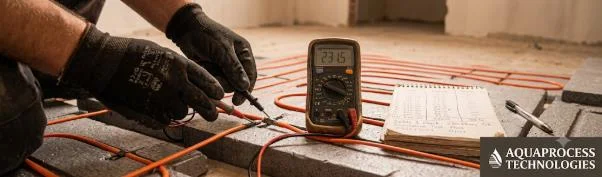
Key checks before choosing an electric underfloor heating vendor
Choosing an electric underfloor heating solution provider or underfloor heating supplier comes down to the following checks:
- Complete technical details. The vendor should have submitted complete details of the calculated heat load, the material and quantity to be installed, and the electrical load, indicated clearly. A proper system for handling excess power loads should be included.
- Insulation. Is insulation included, and is it proper insulation as per site requirements?
- Methodology. What methodology has been offered for doing the job, whatever the job size? It should detail three distinct steps: insulation laying, cable laying and power system installation, and final commissioning and handover. It should clearly include the time gaps required for screeding and screed curing. Have you been given a realistic time frame?
- Testing. Do they include testing at every stage? This is a mandatory requirement.
- The product itself.
- Is a well-known brand from a well-established and reputed manufacturer being offered?
- Do the cables have quality and safety certificates issued by competent authorities?
- Is the sourcing and supply being done in conformity with the law?
- Will the product packages carry full specifications, identification marks, and the manufacturer's contact details?
- Do the product guarantees have the manufacturer's backing? Is the brand being offered under authority, or just sourced from somewhere? Read more on what to verify in a Danfoss underfloor heating partner.
- Experience. What is the vendor's experience and standing in the industry?
- Confidence. Last but not least, does the vendor sound confident and reassuring when discussing the offer? Are they afraid of competition? Are they putting most of the emphasis on price alone? Your instincts will tell you that instantly.
Honestly, only a technically sound and competent vendor can deliver all this and much more, as discussed in the sections below.
What should an electric underfloor heating vendor provide before work starts?
A good vendor's work begins well before the first cable is laid on site.
- Detailed planning with every stakeholder. The vendor works in close association with architects, project teams, and electrical teams, or with owners directly. They consider all relevant factors: floor finishes, the various layers that go under the floor and the thickness they take, the effect on available head space after finishing, door sizes, window heights, and the best location for thermostats for the owner's liking and convenience. They work out the best working details and finalise them well in advance. Alongside this, they discuss power loads, arrangements to handle them, cable and wire sizes, and wiring circuits and diagrams. These are finalised too, so that every stakeholder is absolutely clear about what is required, what is to be done, what is the vendor's scope, and what is the owner's scope.
- Close coordination on site. Once the details are finalised, the vendor stays in close coordination with project teams, guiding them on what is to be done, when and at which stage, how it is to be done, what precautions are to be taken, and what the best methodology is.
- The actual installation. A good vendor deputes experienced, sincere, and responsible teams for the installation. They follow all correct procedures, deliver the best workmanship and accuracy, carry out all the tests, and make sure the installation is genuinely safe and long-lasting, without exceptions.
For more on how planning fits into the overall project, see what to consider before installing a floor heating system in India.
Which tests should the installer run, and when?
Testing is the clearest proof of performance, because the heating element will be buried under the floor. Danfoss guidance says to measure, verify, and record the following:
- Element resistance, as per the cable's individual specifications.
- Actual load (current), meaning the amount of heating being delivered in site conditions at the available voltage.
- Leakage test, to ensure the cable insulation is working. With Danfoss, this is part of standard manufacturing practice and is tested before supply. Danfoss also carries out rigorous tests for electrical safety, mechanical safety, and moisture ingress on the free end and cold-connection sealings. This ensures safety and performance, come what may.
Two further points are extremely important:
- No cutting or joining at site. For underfloor heating, Danfoss supplies pre-sealed cables in standard lengths. Installer teams are not allowed to cut or join them at site, as this would jeopardise the safety and performance built into every cable.
- Loose cable is a red flag. If the vendor brings in a large quantity of loose cable, it is a huge red flag. It simply means that safety and performance have been thrown out of the window. If cable must be cut and joined at site, it should only be done with the manufacturer's special connectors, in the exact manner the manufacturer specifies. Treating it as just another electrical joint is the worst thing to do, and any last chance of safety is gone.
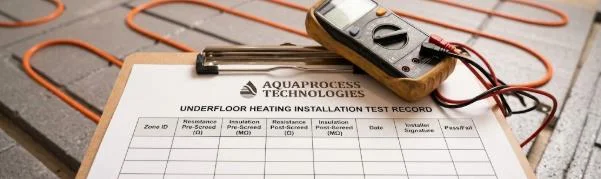
The tests must be carried out at the following stages:
- Upon unpacking and before installation.
- Post-installation.
- Confirmatory tests at the time of commissioning.
Ask your installer to share these readings in writing, for every zone and every stage.
Any faulty cable should be replaced. There should be no repairs or joints in new cables used for underfloor heating.
What does proper commissioning and handover include?
Commissioning is more than switching the system on. It should include the following:
- You receive the recorded test readings, confirming that they tally with the results recorded earlier.
- A walkthrough showing the thermostats working smoothly.
- Actual witness that the heat is coming through: the floors are getting warm and the space is getting warm.
- Proper guidance on using the system. This covers keeping a time gap between switching on different portions in the first few days, the precautions required to prevent any damage or malfunction of cables, and what to keep a watch on in the electrical system, so that you are fully comfortable with the system and can enjoy it to the fullest.
- Contact details for any issue arising after commissioning.
- The warranty in writing. AQUAPROCESS supplies Danfoss cables with a 20-year guarantee and thermostats with a 2-year guarantee. With AQUAPROCESS, your invoice itself works as the guarantee.
Electric underfloor heating is a long-term investment that sits under your floor for decades. Choosing a provider who designs carefully, tests at every stage, and supplies genuine, manufacturer-backed products is what makes it safe and reliable. Learn more about electric underfloor heating for Indian homes.
To sort out everything for your own project, book a consultation or download the brochure.